Energy costs are the silent killer of profitability for businesses across Andhra Pradesh. In Kadapa — home to one of the world's largest granite processing clusters, a growing pharmaceutical sector, and a thriving hospitality industry serving Tirumala pilgrims — commercial electricity tariffs from APSPDCL range from ₹8 to ₹12 per unit for LT commercial connections and significantly higher for HT industrial consumers. For a mid-sized granite polishing unit consuming 15,000 units monthly, that translates to electricity bills exceeding ₹1.5 lakh every month.
Commercial solar in Andhra Pradesh offers these businesses a proven path to slash energy overheads by 60–80%, claim substantial tax benefits through accelerated depreciation, and achieve payback in as little as 24–36 months. ELRIX ENERGY — Nellore-headquartered and serving Kadapa, Nellore, Tirupati, and Ongole — has designed and commissioned commercial solar installations from 10 kW retail rooftops to 200 kW+ industrial arrays. This guide explains why Kadapa businesses are going solar in 2026 and how to evaluate commercial solar for your facility.
Why Kadapa Businesses Are Switching to Commercial Solar
Kadapa district presents a compelling case for commercial solar adoption due to a convergence of economic, environmental, and policy factors unique to the Rayalaseema region:
- High solar irradiance: Kadapa receives 5.2–5.5 peak sun hours daily — among the highest in Andhra Pradesh. Inland location means less cloud cover during monsoon compared to coastal Ongole, producing consistent year-round generation.
- Energy-intensive industries: Granite processing, cement, pharmaceuticals, and cold storage facilities consume massive continuous power. Even a 20% bill reduction on a ₹2 lakh monthly bill saves ₹4 lakh annually.
- Rising APSPDCL tariffs: Commercial and industrial tariffs have increased 5–7% annually over the past decade — faster than residential rates. Solar hedges against this escalation permanently.
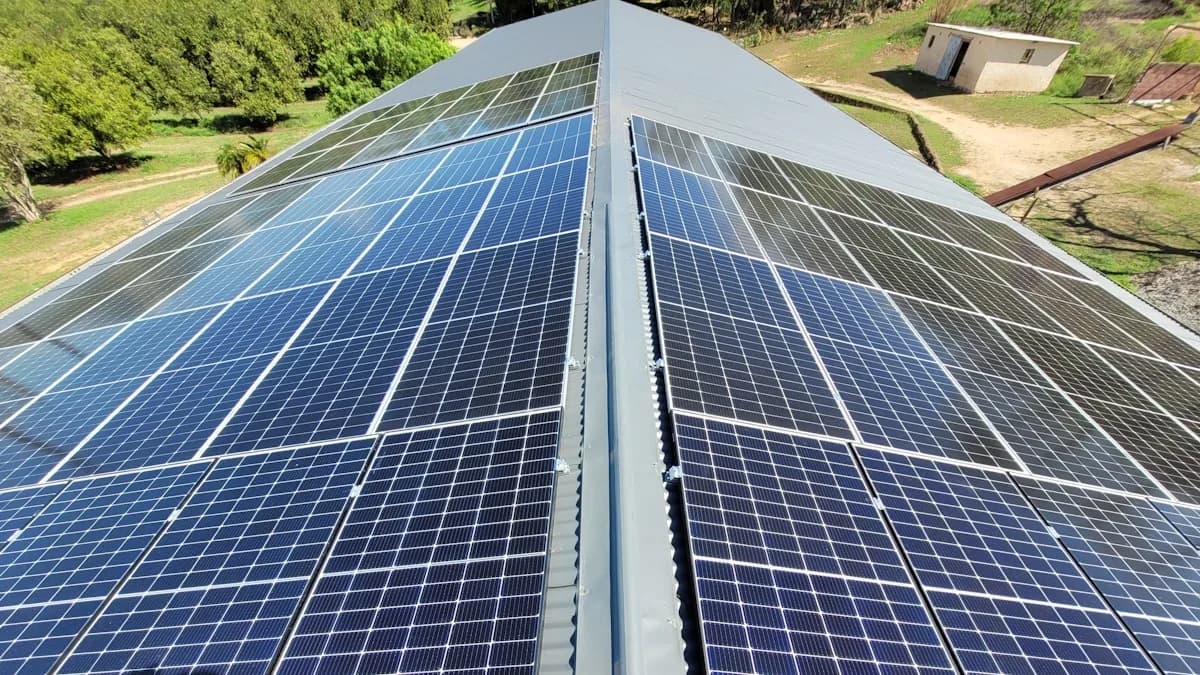
- Available rooftop space: Kadapa's industrial estates — APIIC Kadapa, Yerraguntla industrial area, and Proddatur textile zone — feature vast flat factory rooftops ideal for large-scale PV arrays with minimal structural modification.
- Government push: Andhra Pradesh targets 18 GW of renewable capacity by 2030. Commercial rooftop solar contributes directly to this goal, and APSPDCL has streamlined net metering approvals for LT and HT commercial consumers.
Beyond Kadapa, the same commercial solar economics apply to businesses in Nellore's industrial corridor, Tirupati's hospitality sector, and Ongole's dairy and aquaculture processing plants. ELRIX ENERGY serves all four districts with dedicated commercial engineering teams.
Commercial Solar Pricing and ROI in Andhra Pradesh
Commercial solar pricing follows the same ELRIX ENERGY tier pricing from ₹67,000 for 1 kW (after discount) benchmark as residential installations for systems up to 10 kW. Larger commercial arrays benefit from economies of scale, with per-kW costs dropping to ₹55,000–₹60,000 for 20 kW+ installations due to bulk procurement and simplified logistics on large flat rooftops.
| System Size | Customer Price | Monthly Generation | Monthly Savings (₹10/unit) | Payback Period |
|---|---|---|---|---|
| 10 kW | ₹6,66,000 | ~1,300 units | ₹13,000 | 42 months |
| 20 kW | ₹11,00,000 | ~2,600 units | ₹26,000 | 35 months |
| 50 kW | ₹27,50,000 | ~6,500 units | ₹67,000 | 35 months |
| 100 kW | ₹55,00,000 | ~13,000 units | ₹1,35,000 | 35 months |
These calculations use ₹10/unit — conservative for Kadapa's LT commercial and small HT consumers. Many industrial consumers paying ₹11–₹12/unit achieve payback in 24–30 months. Combined with accelerated depreciation (detailed below), effective payback can drop below 24 months for profitable businesses in higher tax brackets.
PM Surya Ghar residential subsidy (₹78,000 cap) does not apply to commercial installations, but commercial entities access far more valuable tax incentives that residential consumers cannot claim. For a detailed residential pricing comparison, see net costs of ₹37,000 (1 kW) through ₹5.88 lakh (10 kW) on our subsidy page.
Accelerated Depreciation: The Hidden Tax Advantage
The single most powerful financial lever for commercial solar in Andhra Pradesh is Accelerated Depreciation (AD) under Section 32 of the Income Tax Act. Commercial and industrial entities can depreciate 40% of the solar asset's value in the very first year of installation — compared to the standard 15% rate for most capital equipment.
Example for a Kadapa granite processing unit installing 50 kW commercial solar at ₹27.5 lakh:
- Year 1 depreciation: 40% × ₹27,50,000 = ₹11,00,000 deduction from taxable income
- Tax saved (at 30% corporate rate): ₹3,30,000 in Year 1 alone
- Effective net cost after tax benefit: ₹27,50,000 − ₹3,30,000 = ₹24,20,000
- Remaining depreciation: 40% of WDV in Year 2, 40% in Year 3, then normal rates — total depreciation exceeds 80% within 3 years
For partnership firms and LLPs in Kadapa's MSME sector, the tax benefit applies at the partners' individual tax rates (potentially 30%+ for high earners). For companies, the 25% corporate tax rate (for turnover under ₹400 crore) still yields ₹2.75 lakh Year 1 savings on the same 50 kW example.
No other capital investment available to Kadapa businesses — machinery, vehicles, building improvements — offers 40% first-year depreciation. Commercial solar is uniquely advantaged in India's tax code, reflecting the government's strategic priority on renewable energy adoption.
APSPDCL Commercial Net Metering Explained
Commercial net metering under APSPDCL follows the same import-export principle as residential but with additional considerations for Kadapa's business community:
Sanctioned load alignment: Solar capacity cannot exceed 100% of your contracted demand without a load enhancement application. A factory with 80 kW sanctioned load can install up to 80 kW solar without DISCOM approval for load increase.
Time-of-Day (ToD) tariffs: HT consumers face higher rates during peak hours (typically 6 PM–10 PM). Solar generates maximum output at midday (10 AM–3 PM), naturally offsetting lower-rate daytime consumption. ELRIX ENERGY's commercial team models ToD impact precisely for each client's tariff schedule.
Demand charge reduction: HT bills include demand charges based on peak kW draw. Solar reduces daytime peak demand from grid, lowering both energy and demand components. For a Kadapa cold storage facility, demand charge reduction alone can save ₹15,000–₹25,000 monthly.
Billing cycle: Commercial net metering credits apply monthly with surplus carry-forward. APSPDCL Kadapa division processes commercial applications through the same portal as residential, with additional requirements for GST registration and company incorporation documents.
ELRIX ENERGY manages the complete commercial net metering application — including load flow studies for larger installations — as part of our commercial solar EPC service.
Industry-Specific Commercial Solar Applications in Kadapa
Granite processing units: Kadapa district processes millions of square feet of granite annually. Polishing machines, cutting saws, and water pumps run continuously during production hours (8 AM–6 PM) — perfectly aligned with solar generation peaks. A typical mid-size unit with 100 kW solar saves ₹1.3 lakh/month, achieving payback in 30 months before counting depreciation benefits.
Pharmaceutical and chemical plants: Proddatur and Kadapa city host pharmaceutical formulation units requiring climate-controlled environments. HVAC loads during daytime are substantial, and solar directly offsets this consumption. 24/7 operations benefit from net metering credits offsetting night-time grid draw.
Hotels and hospitality: Kadapa serves as a gateway for Tirumala pilgrims, with dozens of hotels, lodges, and restaurants along the Kadapa-Tirupati highway. AC loads peak during afternoon check-ins (12 PM–4 PM), coinciding with maximum solar output. A 20 kW hotel installation saves ₹20,000–₹26,000 monthly.
Cold storage and warehouses: Compressor loads run continuously, making cold storage one of the highest-consumption commercial categories. Large flat rooftops above cold storage units are ideal for 50–200 kW arrays with minimal structural modification.
Educational institutions: Kadapa's engineering colleges, medical colleges, and schools operate primarily during daylight hours — the ideal consumption profile for solar. A 30 kW campus installation saves ₹25,000+/month while demonstrating environmental leadership to students and accreditation bodies.
Retail and showrooms: LT commercial connections along Kadapa's main commercial streets benefit from simpler net metering approval and lower installation complexity. 10–20 kW systems fit standard retail rooftops and pay back within 36 months.
Commercial Solar vs DG Sets: The Total Cost Comparison
Many Kadapa businesses rely on diesel generator (DG) sets for backup power during load-shedding — particularly in industrial fringe areas and rural mandals. DG sets carry hidden costs that commercial solar eliminates entirely:
| Cost Factor | Diesel Generator (50 kVA) | 50 kW Commercial Solar |
|---|---|---|
| Capital cost | ₹5–₹8 lakh | ₹27.5 lakh (but saves ₹67,000/month) |
| Monthly fuel cost | ₹40,000–₹60,000 | ₹0 |
| Monthly maintenance | ₹5,000–₹8,000 | ₹1,000–₹2,000 |
| Noise and pollution | High | Zero |
| Tax benefit | Standard depreciation (15%) | Accelerated depreciation (40% Year 1) |
| 25-year total cost | ₹1.5–₹2 crore (fuel alone) | ₹27.5 lakh one-time + ₹5 lakh maintenance |
Commercial solar does not provide backup power during grid outages (unless paired with battery storage or hybrid inverters), but it dramatically reduces grid dependency and operating costs during normal operation. For Kadapa businesses spending ₹50,000+/month on DG fuel alone, solar savings often exceed total DG operating costs within the first year.
Design and Engineering Considerations for Kadapa Commercial Installations
Commercial solar in Kadapa requires engineering expertise beyond residential installation. ELRIX ENERGY's commercial division addresses several critical design factors:
Structural load analysis: Factory rooftops in Kadapa's industrial estates must support 12–15 kg/m² additional load from panels and mounting. Our civil engineers conduct structural assessments and provide stamped certificates for APSPDCL and factory inspectorate compliance.
Grid synchronization: Systems above 10 kW require grid-tied inverters with proper anti-islanding protection, voltage ride-through capability, and harmonic distortion limits per APSPDCL technical standards. We specify commercial-grade inverters from Sungrow, Growatt, or equivalent Tier-1 manufacturers.
Cable routing and safety: Commercial installations involve longer DC cable runs, higher voltages, and integration with existing LT panels or HT substations. ELRIX ENERGY designs cable trays, DC combiner boxes, and AC distribution upgrades per IS standards and APSPDCL requirements.
Monitoring and reporting: Commercial clients receive web-based monitoring dashboards tracking real-time generation, cumulative savings, CO₂ offset, and performance ratio. Monthly automated reports support CSR documentation and board-level reporting on sustainability metrics.
Maintenance contracts: Annual Maintenance Contracts (AMC) include quarterly panel cleaning, inverter health checks, connection tightening, and thermographic inspection — ensuring peak performance across Kadapa's dusty industrial environment.
Financing Options for Kadapa Commercial Solar
Capital expenditure concerns stop many Kadapa business owners from proceeding despite compelling ROI. Several financing pathways make commercial solar accessible without straining working capital:
- Solar-specific NBFC loans: IREDA-affiliated lenders offer commercial solar loans at 9–11% interest with tenure up to 7 years. EMI is typically lower than monthly savings — cash-flow positive from Month 1.
- Term loans from commercial banks: SBI, Andhra Bank, and Canara Bank offer green energy loans with preferential rates for MSME solar installations. 40% accelerated depreciation improves post-tax EMI affordability.
- CAPEX vs OPEX (PPA model): Third-party PPA providers install and own the system on your Kadapa rooftop, selling you power at ₹4.50–₹5.50/unit — 40–50% below APSPDCL rates. Zero upfront cost, but lower long-term savings compared to ownership.
- MSME subsidy schemes: Government of Andhra Pradesh and Government of India MSME schemes occasionally offer capital subsidies for energy efficiency investments. ELRIX ENERGY tracks active schemes and assists with applications.
For a Kadapa business considering 50 kW solar at ₹27.5 lakh: a 5-year loan at 10% interest yields EMI of approximately ₹58,000/month against savings of ₹67,000+/month — net positive cash flow from the first billing cycle. Contact our commercial team for financing guidance tailored to your business profile.
Regulatory Compliance and Permits for Commercial Solar in AP
Commercial solar installations in Kadapa must comply with several regulatory frameworks. ELRIX ENERGY manages all compliance as part of our EPC scope:
- APSPDCL net metering approval: Online application with company documents, load details, and system design. Timeline: 15–30 days for LT commercial, 30–45 days for HT.
- CEIG inspection: Chief Electrical Inspector to Government of Andhra Pradesh inspection required for systems above 10 kW. ELRIX ENERGY coordinates scheduling and ensures installation meets CEIG standards.
- Factory inspectorate: Structural load additions on factory buildings may require notification to the factories department. Our structural certificates satisfy this requirement.
- ALMM compliance: While PM Surya Ghar subsidy is residential-only, APSPDCL requires ALMM-listed modules and inverters for all grid-connected installations receiving net metering approval.
- Fire safety: Commercial buildings may require fire department NOC for electrical modifications. ELRIX ENERGY's designs include DC isolators, fire-rated cable routing, and signage per NFPA guidelines.
Attempting to navigate this compliance landscape without an experienced commercial EPC is the primary reason Kadapa businesses report failed installations and delayed net metering from unqualified vendors. ELRIX ENERGY's commercial track record across Nellore, Kadapa, Tirupati, and Ongole eliminates this risk.
Getting Started: Your Kadapa Commercial Solar Roadmap
The fastest path from inquiry to operational commercial solar in Kadapa begins with a 48-hour feasibility assessment from ELRIX ENERGY. Share your last three APSPDCL bills, sanctioned load details, and rooftop photographs. We deliver a comprehensive report covering recommended system size, gross and net investment, monthly savings projection, accelerated depreciation tax benefit, APSPDCL net metering timeline, and 25-year cash flow analysis. Most Kadapa business owners who receive this report proceed to installation within 30 days — because the numbers speak for themselves when energy overheads threaten margins every single month.
Frequently Asked Questions
How much can Kadapa businesses save with commercial solar?
Most commercial installations reduce energy costs by 60–80%. A 50 kW system saving ₹67,000/month at HT commercial tariffs pays back in 30–35 months, then generates free power for 20+ years.
What is accelerated depreciation for commercial solar?
Section 32 of the Income Tax Act allows 40% depreciation on solar assets in Year 1 — versus 15% for standard equipment. On a ₹27.5 lakh installation, this saves ₹3.3 lakh in corporate tax in the first year alone.
Does PM Surya Ghar subsidy apply to Kadapa businesses?
No. PM Surya Ghar is residential-only (₹30,000–₹78,000). Commercial entities benefit from accelerated depreciation, higher tariff savings, and demand charge reduction instead. See our subsidy page for residential details.
What size commercial solar system does my Kadapa factory need?
System size depends on rooftop area, sanctioned load, and consumption pattern. Rule of thumb: install up to 100% of sanctioned load or enough to cover 70–80% of daytime consumption. ELRIX ENERGY provides free load analysis.
How long does commercial net metering approval take in Kadapa?
APSPDCL Kadapa division typically processes LT commercial applications in 15–30 days and HT applications in 30–45 days. ELRIX ENERGY manages the complete application and inspection coordination.
Can solar power run granite processing machinery in Kadapa?
Solar offsets grid consumption during production hours (8 AM–6 PM). Heavy machinery runs on grid-solar blend via net metering — not directly from panels alone. Savings come from reduced grid imports, not off-grid operation.
What is the cost of commercial solar per kW in AP?
ELRIX ENERGY tier pricing from ₹67,000 for 1 kW (after discount) for systems up to 10 kW. Larger arrays (20 kW+) benefit from scale economies at ₹55,000–₹60,000/kW. Contact our commercial team for volume pricing.
Is commercial solar viable for Kadapa hotels?
Highly viable. Hotels consume maximum power during afternoon hours (AC, lighting, kitchen) when solar output peaks. A 20 kW installation saves ₹20,000–₹26,000/month with 30–36 month payback.
Can I claim GST input credit on commercial solar installation?
GST treatment on solar installations has specific rules. Currently, solar EPC services attract 8.9% effective GST (70% of 13.8% rate on 70% of value). Consult your CA for input credit eligibility on your specific business structure.
What warranty does ELRIX ENERGY offer on commercial installations?
5-year comprehensive workmanship warranty, 25-year panel performance warranty, and 5–10 year inverter warranty depending on manufacturer. Annual maintenance contracts available for Kadapa industrial clients.
How does commercial solar ROI compare to residential in Kadapa?
Commercial ROI is typically 2–3× faster due to higher tariffs (₹8–₹12/unit vs ₹6–₹8), accelerated depreciation, and demand charge reduction. Commercial payback: 24–36 months vs residential 40–55 months.
How do I get a commercial solar quote for my Kadapa business?
Contact ELRIX ENERGY with your last 3 APSPDCL bills and rooftop dimensions. We provide a free commercial feasibility report with ROI, depreciation benefits, and net metering timeline within 48 hours.